It’s always a tragedy when a parent has to bury a child. More so when the parents can’t agree on the child’s funeral arrangements.
Kaleb Best died in a car crash in February 2026. He was unmarried and had no kids. He did not have a will.
Kaleb’s mum and dad were not on good terms, so a dispute arose about his funeral arrangements.
Kaleb’s mum and dad couldn’t resolve the dispute, so Kaleb’s mum (Ms Suarez) asked the Supreme Court to determine who should be responsible for the funeral.
The case came before Justice Strk on the 26th and 27th of February 2026, and, given the urgency, the decision was delivered at the conclusion of the hearing.1
Jurisdiction
The Court has jurisdiction to determine who should have carriage of a funeral, and where and how a body should be disposed of pursuant to section 4 of the Administration Act 1903 (WA), and the inherent jurisdiction of the Court [11].
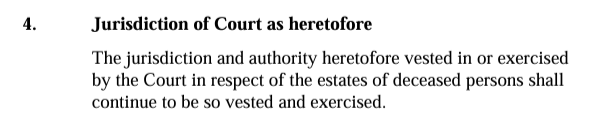
Section 4 of the Administration Act (below) doesn’t say much of anything, but essentially means that the Court has the same jurisdiction that it had prior to that Act, which was the same jurisdiction it inherited from the ecclesiastical courts of England and Wales.
The Court’s inherent jurisdiction is a tricky concept, but basically means that the Supreme Court has the power to do whatever it needs to do to:
…ensure the observance of the due process of law, to prevent vexation or oppression, to do justice between the parties and to secure a fair trial between them.2
Key Principles
Justice Strk referred to an earlier judgment of the Court of Appeal in Britt v Office of the State Coroner [2022] WASCA 75, in which the Court held that:
- Where there is no will, the body will ordinarily be released to the person who appears to be most likely to receive a grant of letters of administration (usually the person with the greatest interest in the estate).
- This approach is not rigidly applied and it depends on all the circumstances of the case.
- The Court must take into account:
- cultural considerations;
- the deceased’s wishes and the wishes and sensitivities of living close relatives; and
- the need for the funeral and burial to be held in a timely way, and the costs and practicalities of competing proposals.
- The decision about who the body should be released to and who should take charge of the funeral does not involve a final determination of who will ultimately be granted letters of administration.
Key features of the evidence
Justice Strk determined that both Ms Suarez and Mr Brunsdon had equal entitlement to apply for a grant of letters of administration [64].
There was no evidence of Kaleb’s wishes [65].
A close family member (Kaleb’s paternal uncle) and Mr Brunsdon were supportive of Ms Suarez’s proposal as to the location of the funeral service [68]–[69].
The determining factors in this case appear to be that Ms Suarez was already well advanced in the arrangements for the funeral and that those arrangements included Mr Brunsdon’s side of the family.
Mr Brunsdon was less advanced in his planning, and his plan would involve transferring Kaleb’s remains to a different funeral director. There were also concerns (due to some intemperate text messages) that Mr Brunsdon might seek to exclude Ms Suarez from the funeral (although this position appeared to have changed by the time of the hearing) [74]–[75].
The orders made by the Court were annexed to the judgment, which is always helpful…
RL
- Link to case here: https://ecourts.justice.wa.gov.au/eCourtsPortal/Decisions/ViewDecision?id=d03e8731-cce1-4a9f-ba8d-70155e59713a ↩︎
- I H Jacob “The Court’s Inherent Jurisdiction” (1970) 23 CLP 23. ↩︎